
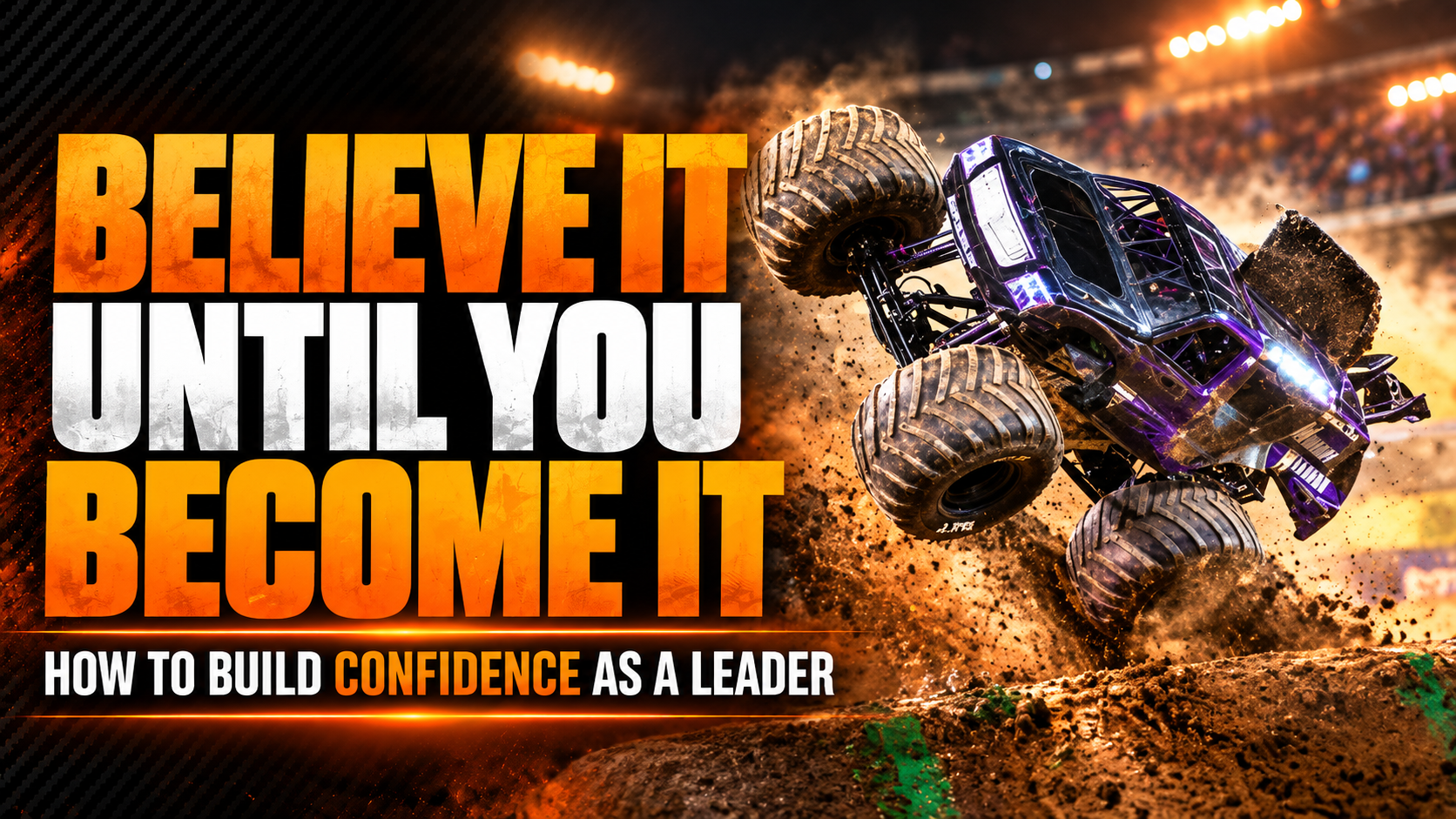
How do you build a high-performance team? Not by asking people to trust each other more. You build systems that make trust repeatable: everyone knows exactly what they own, the work that matters most gets verified, and anybody can speak up before a small mistake becomes a big one.
I'm Bryce Kenny, a Monster Jam driver and team performance keynote speaker, and I drove the Great Clips Mohawk Warrior to a Guinness World Record as the first monster truck to reach 100 mph. At that speed, a 12,000-pound truck can vibrate itself apart. Our team prepared for two months for that run, and I just got to be the one to launch it down the track. I tell the whole story in how to turn pressure into performance.
Everybody sees the one driver up inside that truck. But that performance depends on an entire team of people you'll probably never see. Here's how my crew turns trust into a system, what happens after something breaks, and the three practices I'd take from a Monster Jam crew and put inside your team.
What Makes a High-Performing Team? It Starts With the Crew Nobody Sees
A high-performing team is one where every person owns a piece of the outcome and trusts the people who own the rest. On a Monster Jam team, that work starts long before I climb into the truck.
Before I ever get behind the wheel, our crew chief, Matt, is making sure every component is ready to perform: the suspension, the steering, the drivetrain, the engine, the tires, the fuel system. That's hundreds of details that all have to work together. And in Monster Jam, we put that equipment through an unbelievable amount of abuse.
On event day, Matt is out there inspecting the truck, making last-minute adjustments, checking critical components, and preparing it for what we're about to ask it to do. If something breaks during competition, he has an incredibly small window to diagnose the problem, fix what I broke, and get us back out on the track.
What makes that so remarkable is how much ownership every single person on our team has to have. I might be the one holding the steering wheel, but I can't personally inspect every bolt, rebuild every component, or make every decision. I have to trust the people who are better at their jobs than I am.
That's something I think leaders really struggle with. They want high-performing teams, but they still want to be involved in every single decision. I've learned that my performance has a ceiling if the people around me aren't empowered to perform at their best. The strongest teams are built when everyone understands:
What they own
How it affects the outcome
Why their contribution matters
That's the heart of the Engagement gear in my G.E.A.R. Framework, the four-gear model of Growth, Engagement, Acceleration, and Risk that I use to help teams figure out why they're stuck and which gear gets them moving again. Engagement is about commitment, and people commit fully when they understand their role and believe it matters. When I delivered the framework to a room of KOA franchisees, I put it this way: your organization is only as strong as that one employee who's halfway in.
That's the team-level view. For what full commitment looks like at the individual level, start with the backflip that taught me the difference.
Building Trust in Teams: Make Trust a System, Not a Feeling
If you want to build a high-performance team, building trust in teams has to go further than believing your teammates have good intentions. High-performance teams build systems that make trust repeatable.
Trust on a Monster Jam team has to go deeper than believing somebody means well. When I'm about to climb up into a 12,000-pound truck and launch it through the air, I need to know the work has been done correctly. In my world, that system looks like this:
Critical components get inspected.
Adjustments get verified.
People communicate what they found before the truck goes back out onto the track.
There's accountability built into that process, because everyone understands the consequences of getting something wrong.
Here's the part that surprises people. The best teams don't verify less because they trust each other. Having somebody double-check your work should never be an insult. It should be one of the greatest signs that you're part of a team that takes performance seriously.
Even the most talented people make mistakes, and a strong team creates an environment where those mistakes get caught before they become failures. That's how trust ultimately gets built: you create clear expectations, you verify the important work, and you consistently show that everyone can depend on one another.
Team Accountability Systems: Protect Each Other Instead of Blaming Each Other
Team accountability systems work when they're built to find the problem, not someone to punish. On a high-performance team, accountability is how we protect each other and give everybody the confidence to go out there and perform.
I think corporate leaders could learn a lot from racing here, because sometimes we treat accountability like somebody is in trouble. Monster Jam has taught me that the smallest problem can become a really big problem when you're operating at the limit. When something goes wrong with the truck, the most important conversation usually happens after we've figured out how to get through the immediate situation. Before the next event, we have to understand:
What happened
Why it happened
What we're going to change
That's where team culture gets tested. When something fails, it's easy to start looking for someone to blame. But if everybody is worried about protecting themselves, you're going to have a much harder time finding the actual problem.
So I want people to speak up. I want someone to tell me when they see something I don't. And I want our team to be willing to challenge an assumption, even if we've been doing something the same way 100 times.
That's especially important when you're successful. Success can convince you that your process is working perfectly, right up until the moment you discover something you've been overlooking. The best teams I know treat every mistake, every close call, and every unexpected result as information they can use to improve, because the goal is to be better prepared the next time we face that situation.
3 High-Performance Team Characteristics I'd Borrow From a Monster Jam Crew
The high-performance team characteristics that matter most show up in how a team works, not how it feels. If I could take just three things from a Monster Jam crew and put them inside a corporate team, I'd start with clarity, verification, and the freedom to speak up.
Clarity: everybody knows exactly what they own. One of the biggest problems I see in organizations is that five people are all involved in a decision, but nobody is actually responsible for making it.
Verification: a process for the work that matters most. In racing, we don't rely on somebody remembering every detail under pressure. In business, that might mean a checklist, a second set of eyes, or a five-minute review before an important decision goes out the door.
Freedom to speak up: it's normal to challenge what doesn't look right. This is probably the most overlooked one. A high-performance team needs people who care enough about the outcome to raise their hand, even when it's uncomfortable.
This is also where I think a lot of team-building programs miss. They spend way too much time trying to make everybody feel connected without addressing how the team actually works together. Connection matters, don't mishear me. But the real test is what happens when the pressure's on, the timeline gets short, and somebody notices a problem:
Does everyone understand their role?
Can they depend on the process?
Will they speak up before a small mistake becomes a big one?
Those are the pit crew lessons I'd hand any leader trying to build a high-performance team. Ownership is also what keeps a team fast without wearing it out, which I dig into in how to accelerate team performance without burning out your team.
Frequently Asked Questions
What makes a team high-performance?
A high-performance team combines clear ownership, verification of the work that matters most, and the freedom to challenge anything that doesn't look right. Everyone knows what they own, how it affects the outcome, and why their contribution matters. Bryce Kenny, a Guinness World Record holding Monster Jam driver, sees that combination every event day, when his crew chief inspects and prepares the truck before he climbs in.
How do high-performance teams build trust?
They build systems that make trust repeatable instead of relying on good intentions. That means clear expectations, verification of the important work, and consistent proof that everyone can depend on one another. On a Monster Jam crew, critical components get inspected, adjustments get verified, and people report what they found before the truck goes back on the track.
Is accountability the same as blame?
No. Blame looks for someone who's in trouble, while accountability asks what happened, why it happened, and what the team will change before the next time. When people are busy protecting themselves, the real problem gets harder to find. On a high-performance team, accountability is how people protect each other.
Trust You Can Verify Is What Builds a High-Performance Team
To me, a high-performance team is just a group of people who all trust each other enough to take ownership of an outcome that none of them could accomplish alone.
That's my one-sentence answer to how to build a high-performance team. People see me in the truck, but our crew is the reason it's ready to perform.
Trust isn't a feeling you wait for. It's a system you build, and in the G.E.A.R. Framework it's what turns a group of busy people into a fully engaged team. If your team has the talent but not that kind of trust yet, that's where you'll find your next gear.
Bring the Pit Crew Mindset to Your Next Conference
Bryce Kenny brings this message to franchise conventions, corporate conferences, and association events through his G.E.A.R. Framework keynote. If your team has five people involved in every decision and nobody responsible for it, or people who stay quiet when something doesn't look right, this keynote gives them a shared way to own the outcome, verify what matters, and speak up before a small problem becomes a big one.
Book Bryce Kenny to speak to your team → or call (770) 315-2117.