
How to Turn Pressure Into Performance: What a 100.3 MPH Monster Truck Run Taught Me About Leading When It Counts
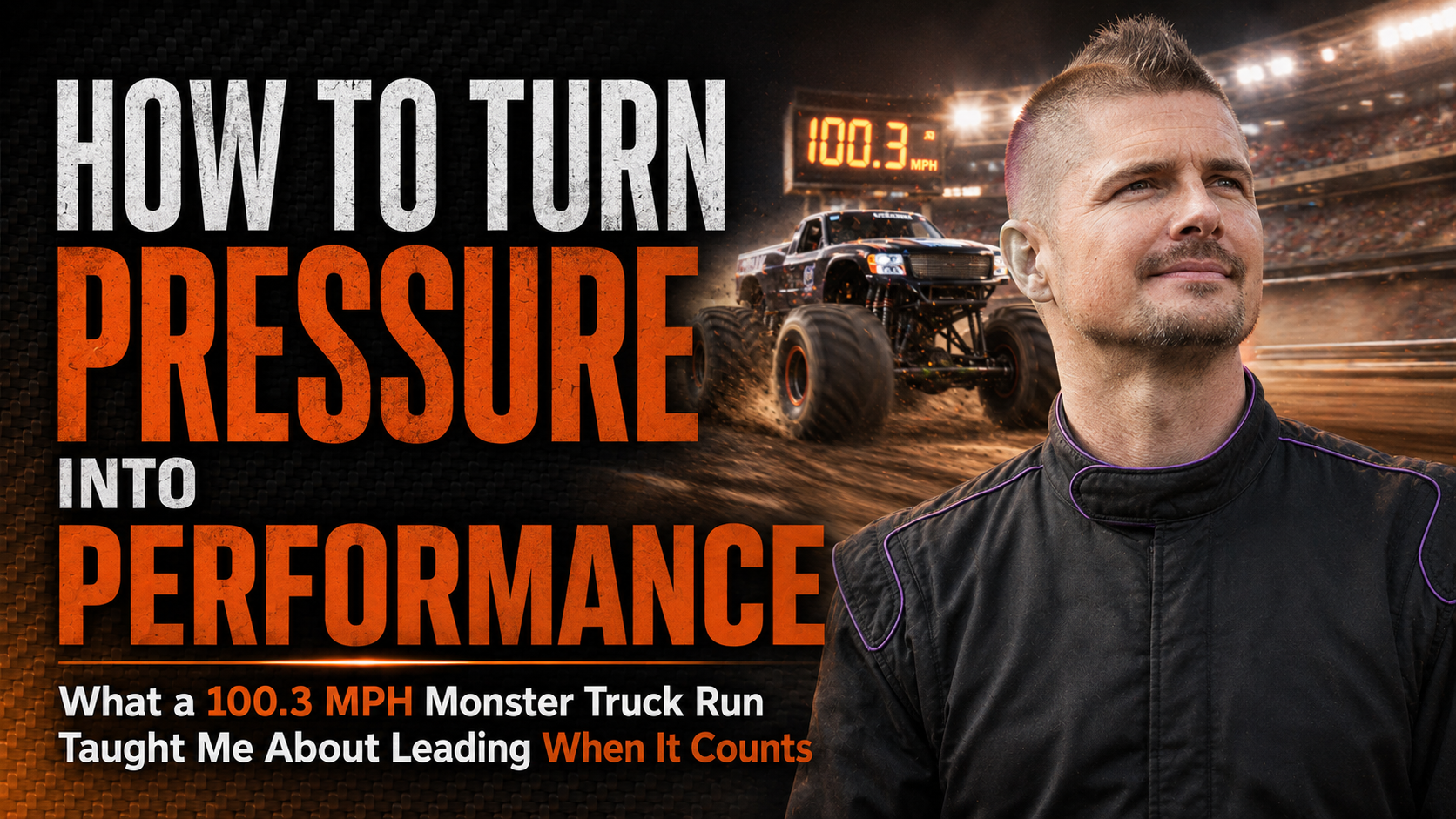
How do you turn pressure into performance? You stop treating pressure as the problem and start treating uncertainty as the problem, then you shrink that uncertainty through preparation. Pressure is usually your body preparing you to perform. What most leaders are actually feeling is uncertainty, and uncertainty is trainable.
I learned that lesson at 100.3 miles an hour. A few years ago, our team set a Guinness World Record as the very first monster truck in the world to hit 100 miles an hour. As a leadership keynote speaker and professional Monster Jam driver, I have felt the same physical sensation in two very different places: strapped into a 12,000 pound truck screaming down a dragstrip, and standing backstage before walking out in front of 5,000 people. My heart races before both. That does not mean I am in danger. It means my body knows the moment matters.
Here is how we prepared for that record, what the run actually felt like, and the one question I now ask before every high stakes moment.
Pressure Is Not the Problem. Uncertainty Is.
Most leaders think pressure is the problem. I do not. Pressure is usually your body preparing you to perform. What leaders are actually experiencing is uncertainty: they do not know what is about to happen, and they mistake that feeling for pressure.
The difference between pressure and fear comes down to where your focus goes. When the idea of breaking the record came to me, I told the team: you are saying no one has ever gone 100 miles an hour. I am saying no one has ever crashed a monster truck at 100 miles an hour either. That thought sits in the back of your mind, and it creates fear if you allow it to.
Fear fixates on the destruction of what could go wrong. Pressure, handled right, becomes fuel. Instead of dwelling on what a crash would look like, I turned that pressure into preparation, and that preparation into performance. The trainable part is not eliminating pressure. It is reducing uncertainty through preparation, so the moment feels familiar before you ever step into it.
Watch the full story below:
What Preparing for the Monster Truck Speed Record Actually Looked Like
The record before ours was 97 miles an hour, and nobody knew what a 12,000 pound truck would do at triple digits. These trucks are built for backflips, huge jumps, and landing as softly as possible. They are not built for speed, and they run on dirt, not concrete. We did not have highly engineered tires spec'd for a 100 mile an hour pass, and we did not know what kind of stress those massive drivetrain gears could take at speeds nobody had ever reached.
So we attacked every unknown we could control:
The freshest set of tires we could get, with the truest tread, so nothing would wobble going down the track. Each of those tires weighs 600 pounds.
The straightest chassis we could find, one that had not been through crashes and tumbles that bend the bars.
An engine built for maximum power, because propelling 12,000 pounds to 100 miles an hour takes everything a 1,500 horsepower engine can give.
Months of safety conversations, because we understood the cost of this moment as much as the reward.
Then Florida humbled us. We scheduled the attempt for the cool of the morning, and learned fast that morning is one of the most humid parts of a Florida day. We measure water grains in the air when we build horsepower, because an engine needs oxygen to make power. The humidity that morning was the same as if we were running in the middle of a rainstorm. In our test passes the day before, we could not even break the old 97 mile an hour record.
So we adjusted the plan. Instead of building to maximum speed near the finish line, we got way more aggressive in the first 150 feet of the run, forcing the supercharger to work harder and pull more air into the engine earlier. The next morning, in front of the Discovery Channel cameras at a live event, the Great Clips Mohawk Warrior became the first monster truck ever to hit triple digits: 100.3 miles an hour.
Inside the Run: When Pressure Peaks, Preparation Takes Over
The best way I can describe going 100 miles an hour in a monster truck is that it felt like being inside a paint shaker at Lowe's. The 1,500 horsepower engine was screaming, the tread on those 600 pound tires was hammering the track, and I could feel every bit of that vibration coming through the steering wheel.
As I approached the finish line, my peripheral vision started going away. Racers call it tunnel vision, and it happens when things get violent enough that your brain stops processing the edges of what you see. I could see right between the track lines and almost nothing else.
Here is what surprised me. The pressure did not subside when I saw the result. It subsided the instant I crossed the finish line, because I knew everything we had put into that moment had finally paid off. I did not even know we had broken the record until I was parking the truck and saw a buddy of mine, one of the other drivers, off to the side pumping his fists in the air. The preparation is what paid off. It created the strategy that let us find the right gear and set a Guinness World Record.
How to Perform Under Pressure as a Leader: One Question That Shrinks Uncertainty
You probably will not drive a monster truck at triple digits this quarter. But you will walk into a board meeting, a difficult conversation, or a presentation where the lights and cameras feel pointed at you, waiting to see whether you succeed or fail. The move is the same one we made on that dragstrip: turn the pressure into preparation, and the preparation into performance.
The one practice I recommend is asking yourself this before every important meeting: what is one thing I can prepare today that will make tomorrow feel more familiar? Every time you answer that question, uncertainty starts to shrink, confidence starts to grow, and what once felt like pressure starts feeling a lot like readiness.
This is the thinking behind the R in the G.E.A.R. Framework, the four gear system I teach: Growth, Engagement, Acceleration, and Risk. The Risk gear is about understanding the cost of a moment as much as the reward, because that record had a very real cost attached. If we had missed it, our industry would have stayed stuck doing what it had always done. I write about that tradeoff throughout my book, Geared for Life. The people who perform under pressure are not fearless. They have simply done the preparation that makes the moment feel familiar.
Frequently Asked Questions
What is the difference between pressure and fear?
Fear fixates on destruction, on what could go wrong if you fail. Pressure is your body signaling that a moment matters, and it can be converted into fuel. The difference is what you do next: fear freezes your focus on the worst case, while pressure can be turned into preparation and then into performance.
Is pressure good or bad for performance?
Pressure itself is usually good. It is your body preparing you to perform in a moment that matters. What hurts performance is uncertainty that gets mistaken for pressure. Reduce the uncertainty through preparation and the same racing heart starts to feel like readiness instead of threat.
How do leaders stay calm in high pressure situations?
They make the moment familiar before it arrives. Before every important meeting, ask what is one thing you can prepare today that will make tomorrow feel more familiar. Preparation shrinks uncertainty, and shrinking uncertainty is what calm under pressure actually is.
What is the monster truck speed record Bryce Kenny set?
Bryce Kenny drove the Great Clips Mohawk Warrior to 100.3 miles an hour, making it the first monster truck ever to reach 100 mph and setting a Guinness World Record. The run took place on a Florida dragstrip during a live Discovery Channel event, breaking the previous record of 97 miles an hour.
Pressure Is a Signal, Not a Threat
The core insight is simple: pressure is not the problem, uncertainty is, and preparation is how you shrink it. That is the same gear shifting mindset behind everything I teach in the G.E.A.R. Framework, whether the stakes are a world record or a Monday morning meeting. If your heart races before the big moment, good. Your body knows the moment matters. Now go make tomorrow feel familiar.
Bring Pressure Into Performance to Your Next Conference
Bryce Kenny delivers this keynote to franchise conventions, corporate conferences, and association events. If your team freezes when the stakes get high, this keynote gives them a repeatable way to turn pressure into preparation and preparation into performance. Call (770) 315-2117 or check Bryce's availability.