

The G.E.A.R. Framework
Find Your Next Gear
The 4-part peak performance model that helps organizations identify exactly why they're stuck and which gear gets them moving again.
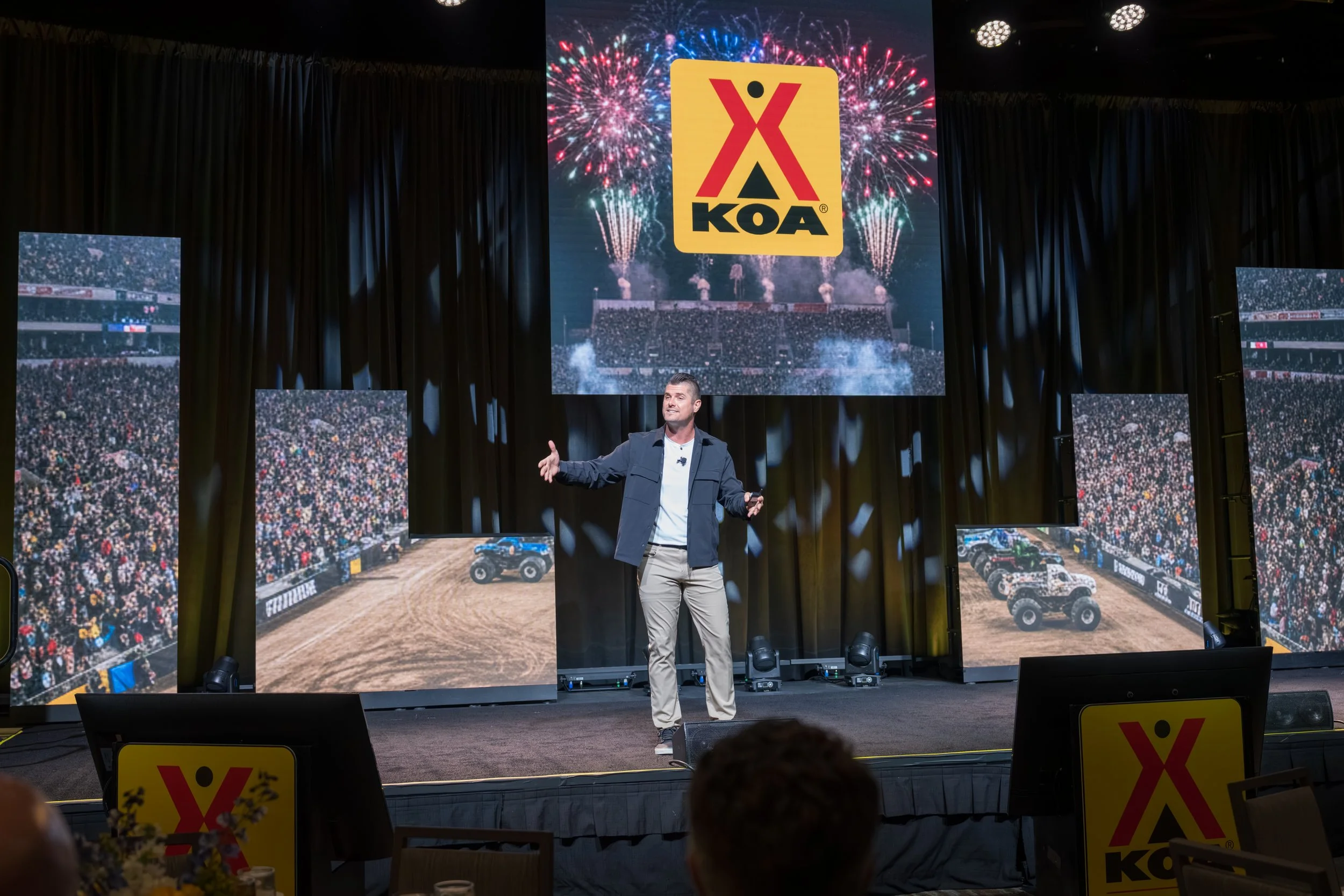
What is the G.E.A.R. Framework? It is a four-part peak performance model created by Bryce Kenny — Guinness World Record holder, 11-year Monster Jam driver, and leadership keynote speaker — that helps organizations identify exactly why they are stuck and what will get them moving again.
G.E.A.R. stands for Growth, Engagement, Acceleration, and Risk. Each gear addresses a different reason teams stall: wrong inputs, half commitment, slow failure cycles, or missing stakes. The framework has been delivered to Deutsche Bank, Chick-fil-A, KOA, Great Clips, Choice Hotels, and 200+ organizations across corporate, franchise, and association conferences.
Bryce developed the G.E.A.R. Framework from two careers that most people never combine: 11 years driving a 12,000-pound Monster Jam truck in front of 55,000 people, and a prior career as a Fortune 500 corporate recruiter watching leaders and teams either find their momentum or lose it. The principles that keep a truck performing at 100 mph are the same principles that keep organizations performing at their best.
The framework is also the foundation of his bestselling book, Geared for Life: Making the Shift into Your Full Potential.

G — Growth: What You Put in the Tank Determines What You Get Out
In a Monster Jam truck, you cannot put 87 pump gas in a 1,500 horsepower engine and expect it to perform. It runs on racing alcohol fuel — a very specific, high-performance input. That is not optional. Without it, the truck does not move.
Bryce learned this the hard way. During a Skills Competition in Houston with 55,000 people watching, he ran out of fuel mid-performance. The truck was built for backflips and 45-foot jumps. It was capable of everything the competition demanded. But the fuel tank was empty, and none of that capability mattered.
The Growth gear is about what you are filling your tank with — not just emptying it. Leaders and teams are getting better at recognizing when they need a break. The problem is what they fill their minds back with afterward. Scrolling social media first thing in the morning. Binge-watching on a mental health day. Taking the time to empty the tank but refilling it with 87 pump gas instead of racing fuel.
Growth is a mindset. It requires a drastic recommitment to personal growth — books, podcasts, real conversations, information that moves you forward instead of keeping you comfortable.
The question is not whether your tank is full. The question is what you filled it with.
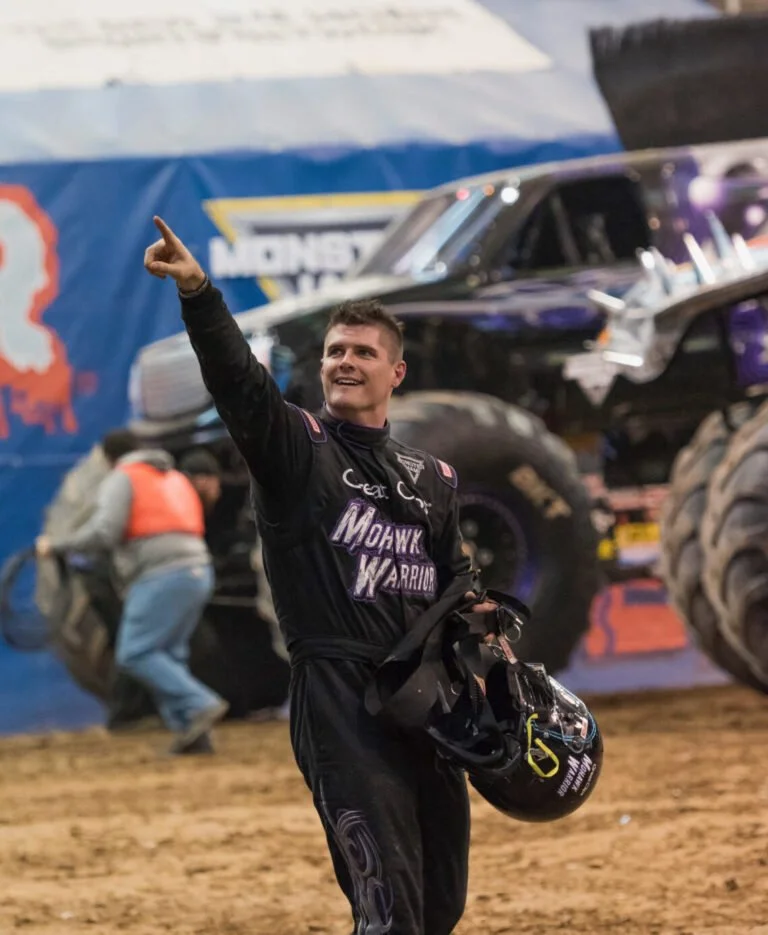
Everybody asks Bryce how you do a backflip in a 12,000-pound truck. The answer is simpler than people expect: pick a focal point, watch it all the way in, hit the obstacle at 100% throttle, and when you see dirt again, hit the brakes.
Bryce's very first backflip attempt tells the real story. It was in Minneapolis — the Vikings stadium. 65,000 people in the seats. 300 corporate employees from Great Clips, the brand-new sponsor. The president of the organization was up in the suites. Monster Jam leaned over to him and said, "Good news — we are going to let Bryce do his very first backflip ever tonight."
What happened next: Bryce turned the corner, lined up the obstacle, and brought his left foot up near the brake pedal to steady the truck on approach. When the truck hit the wall, the impact threw his foot forward just enough to tap the brake. It killed all his momentum. He landed on the roof.
The president of Great Clips leaned over and said, "Well, you could tell it was his first."
The lesson that changed everything: the broken necks in Monster Jam do not happen on full-commitment backflips. They happen on half-committed ones. A foot near the brake — one foot on the throttle and one protecting the backup plan — is not the safe play. It is the dangerous one.
Half commitments are more dangerous than full ones. That is true in a Monster Jam truck and it is true in business. Leaders who have one foot on the throttle and one foot hovering near their backup plan are not protecting themselves. They are putting themselves in the most dangerous position possible.
The Engagement gear asks one question: are you fully committed, or are you hedging?
E — Engagement: Half Commitments Are More Dangerous Than Full Ones
A — Acceleration: Fail Faster to Get Through the Dip
Every new initiative — a new franchise, a new business goal, a new team direction — starts with what Bryce calls uninformed optimism. You do not know what you do not know, and you are excited about it.
Then pessimism sets in. Roadblocks appear. Speed bumps hit. And you enter the dip.
The dip is where most dreams and businesses go to die. They never make it out. But if you can accelerate through the dip — spend as little time there as possible — on the other side is informed optimism. Now you know what you did not know before, and you are excited again.
Bryce lived this in a two-year stretch of his Monster Jam career. Every time he jumped the truck, it landed on the roof. He could not figure out what was wrong. He did not want to jump anymore. He was in the dip.
What got him out was a principle he now teaches to every organization: fail faster. Not fail more. Fail faster. Speed up the failure rate so you learn what you need to learn and get through the dip in the shortest possible time.
When the pessimism hits — treat it as a trigger to accelerate, not to slow down. That is the counterintuitive move that separates teams who get through the dip from teams who stay in it.
This is the gear that changes everything.
Bryce introduces it with the hardest crash of his career — Atlanta Motor Speedway. The truck hit the ground still rotating. He broke 17 chassis bars. He took a chunk out of the track so severe that Atlanta Motor Speedway spent $80,000 repaving the section. The racing simulators that professional drivers practice on still call that section the Bryce Bump.
Why does he subject himself to that? Not for a trophy. Trophies are not bad — Bryce has never given one back. But if the trophy is the only motivation, and a year without it feels like a failure, then you are missing the real opportunity.
Bryce puts himself through 11 years of extreme physical toll because of what is actually at stake. A kid hopped up on cotton candy who might leave that stadium inspired for the first time. A family that could only afford one event that year. A moment that could be the only memory they make together all year.
The principle: date the trophy, but marry the stakes.
The people who perform at the highest level — in motorsports, in franchise leadership, in corporate organizations — always have something to lose. That is what drives the performance. External motivation fades. The trophy gets dusty. But when you are connected to what is truly at stake, you do not mail it in. Not in the stadium. Not in the boardroom. Not in the franchise.
Read how to turn pressure into performance.
R — Risk: Date the Trophy, Marry the Stakes
How Organizations Apply the G.E.A.R. Framework
The G.E.A.R. Framework is not a theory.
It has been applied at organizations ranging from Deutsche Bank to Chick-fil-A to KOA franchise owners to Great Clips — across corporate leadership teams, franchise annual conventions, and association conferences.
In practice, G.E.A.R. helps leaders diagnose what is actually stalling their team:
If the team is running on empty despite working hard — it is a Growth problem. What are they filling their tanks with?
If the team is hedging, protecting backup plans, or going halfway — it is an Engagement problem. Where is the foot near the brake?
If the team is stuck in a performance plateau and the pessimism is building — it is an Acceleration problem. They need to fail faster, not slow down.
If the team is chasing trophies without connecting to what is actually at stake — it is a Risk problem. They are dating the trophy instead of marrying the stakes.
The framework gives leaders and their teams a common language for momentum. When someone in the room says "we are in the dip," everyone knows what that means and what to do about it. When someone says "that is 87 pump gas," the team recognizes the Growth gear issue immediately.
90 days after a G.E.A.R. keynote, the organizations that implement it report teams using the language, recognizing which gear they are stuck in, and self-correcting before the stall becomes permanent.

What is the G.E.A.R. Framework?
The G.E.A.R. Framework is a peak performance model created by Bryce Kenny. G stands for Growth — what you put in the tank determines what comes out. E stands for Engagement — half commitments are more dangerous than full ones. A stands for Acceleration — fail faster to get through the dip. R stands for Risk — date the trophy, marry the stakes. The framework is the foundation of Bryce's keynotes and his book Geared for Life.
Who created the G.E.A.R. Framework?
Bryce Kenny — Guinness World Record holder, 11-year professional Monster Jam driver, Fortune 500 corporate recruiter, and leadership keynote speaker. He developed the framework from two careers that most people never combine: extreme performance in professional motorsports and corporate leadership development.
What organizations use the G.E.A.R. Framework?
The G.E.A.R. Framework has been delivered to Deutsche Bank, Chick-fil-A, KOA (Kampgrounds of America), Great Clips, Choice Hotels, Oakley, Discovery Channel, NBCSN, St. Jude Children's Research Hospital, and 200+ organizations. It is applied in corporate conferences, franchise annual meetings, and association events.
How is the G.E.A.R. Framework different from change management?
Change management focuses on processes and systems for implementing organizational change. The G.E.A.R. Framework focuses on the human performance principles that determine whether people engage fully or go halfway — the energy and commitment side of momentum. It was built from 11 years of performing under extreme pressure, not from management consulting theory.
How do I bring the G.E.A.R. Framework to my organization?
Bryce Kenny delivers the G.E.A.R. Framework as a 45-minute keynote, 60-minute keynote, or half-day workshop. All formats are customized for your organization's theme and audience. Submit a booking inquiry at https://www.brycekenny.com/contact. Bryce's team responds within one business day.
Frequently Asked Questions
Bring BRYCE’S G.E.A.R. Framework to Your Next Conference
Bryce Kenny delivers this framework to franchise conventions, corporate conferences, and association events. If your team is stuck — running on empty, hedging their commitment, trapped in the dip, or chasing trophies without connecting to what is actually at stake — this keynote gives them a framework they will still be using 90 days later.