
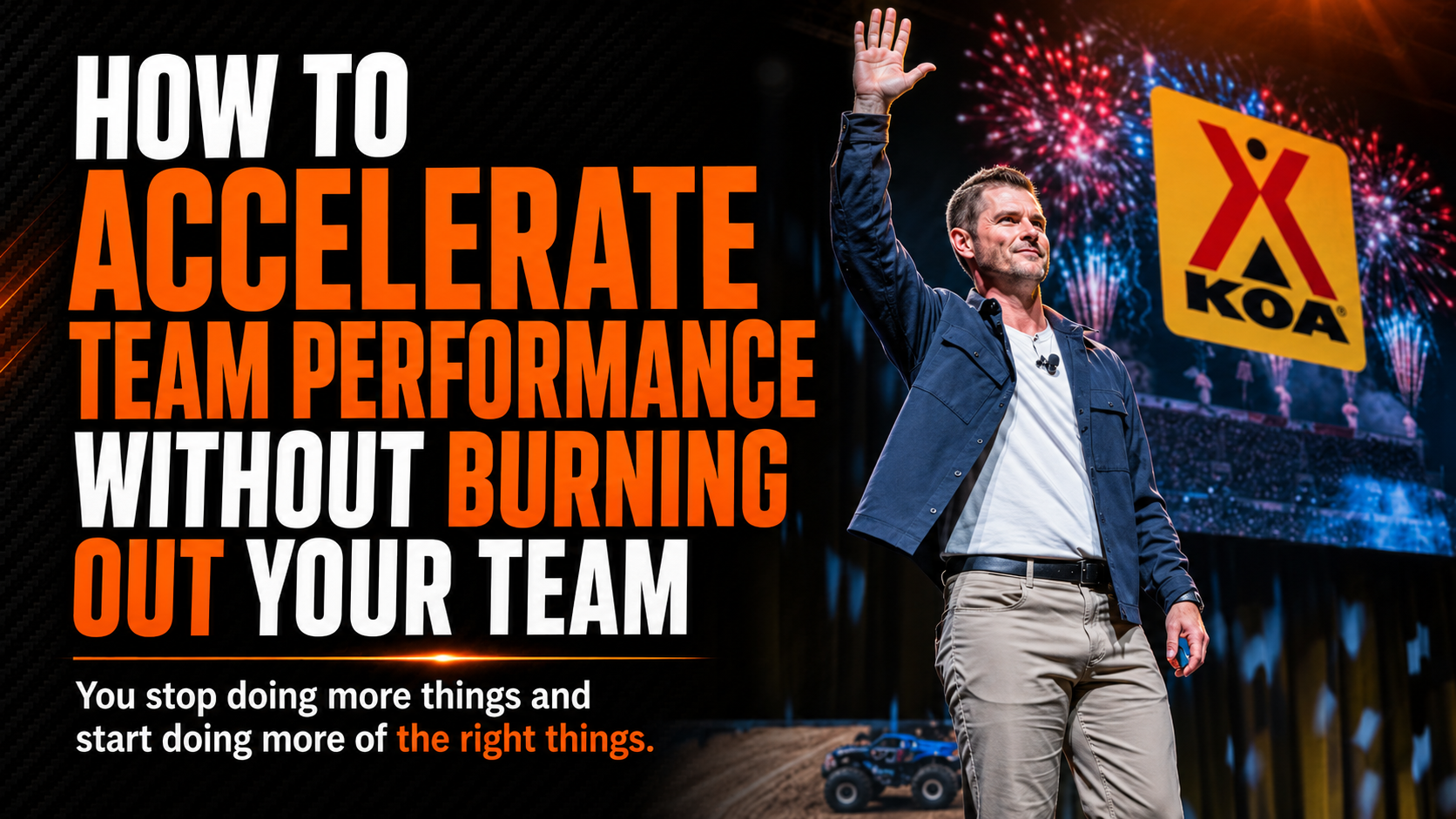
How do you accelerate team performance without burnout? You stop doing more things and start doing more of the right things. Then you make sure your people own the outcome, not just the task list. That combination, acceleration paired with healthy risk, is what separates teams that sustain high performance from teams that spike and crash.
I'm Bryce Kenny, a Guinness World Record holder in Monster Jam and a leadership keynote speaker who works with organizations like Deutsche Bank, Chick-fil-A, and KOA on exactly this problem. And I can tell you from firsthand experience on the track and inside franchise boardrooms: the teams that burn out are almost never the teams doing the most work. They're the teams doing the most unnecessary work. They confuse motion with progress and incentives with ownership. Both mistakes will cost you your best people.
This is the core of the Acceleration and Risk gears inside my G.E.A.R. Framework, four interconnected gears (Growth, Engagement, Acceleration, Risk) that I deliver to corporate conferences and association events to help leaders build momentum that actually lasts.
Here is what I've learned, and what I tell leadership teams when they bring me in.
Watch the full story below:
The Difference Between a Busy Team and an Accelerating Team
Most leaders can't tell the difference between a team that is busy and a team that is accelerating. From the outside, both look like they're working hard. Both have full calendars. Both have people showing up to meetings.
But the behavior inside those meetings is completely different.
A busy team walks into meetings with half-formed ideas that aren't really ready for a decision yet. Instead of moving on that idea, the team keeps talking about it. Another meeting gets scheduled. The decision slows down. Eventually, hesitation becomes part of that team's culture.
An accelerating team's calendar looks different. They spend less time trying to talk their way into the perfect answer and more time testing their way toward it. Their mindset is: we're going to find the ways that work through the ways that don't. Failure is not something to avoid. Failure is the roadmap that helps them make the next decision faster.
If you sit in on a meeting and the team is debating an idea for the second or third time without any new data on the table, you're watching a busy team. If the team tested something since the last meeting, learned from it, and is already adjusting, you're watching a team that knows how to accelerate team performance without burnout.
That distinction matters for HR directors and L&D leaders because busy teams burn out. Accelerating teams build momentum that carries them forward.
The One Thing That Slows Organizations Down When They Try to Accelerate
The thing that slows most organizations down when they're trying to accelerate is over-diagnosing what went wrong. In the first week, they schedule post-mortems, collect more feedback, pull more people into meetings, and delay the next decision until everybody agrees on exactly why the latest attempt failed. They go from action to talking again.
It feels like acceleration because the calendar is full and the team is busy analyzing everything. But speed stops when you keep studying a lesson that you should have already been applying.
I see this pattern constantly. A team runs a pilot, it doesn't hit the target, and instead of identifying the one useful lesson and adjusting, they commission a full review. Three weeks later, they're still discussing the findings. Meanwhile, the window closed and the team's energy drained.
Accelerating teams still learn from failure. But they don't wait for a perfect diagnosis. They identify the latest useful lesson, make a small adjustment, and go test again. Failure becomes a roadmap for the next move, not a reason to delay.
This is the Acceleration gear inside the G.E.A.R. Framework: doing more of the right things, not just doing more things. I'm a big believer that the distinction between those two ideas is what separates teams that build sustainable performance from teams that grind themselves down.
Why Healthy Risk Keeps a Team Performing at a High Level
The Risk gear in my framework surprises people because it sounds counterintuitive. Most organizations try to reduce risk. But what I've seen, across franchise organizations, corporate teams, and my own career in Monster Jam, is that healthy risk creates better performance because ownership always outlasts incentives.
Here is what I mean. The highest performers out there don't give 100% because someone offers them a bigger reward. They give 100% because they understand what's at stake and they believe the outcome belongs to them. They own it.
Most organizations motivate people backwards. Leadership identifies a problem. Leadership creates the solution. Leadership announces the plan. Then they offer a reward to the team members to execute on that plan. The assumption is that a bigger incentive will create greater effort. Sometimes it does. But only for a little while. It never lasts for long.
High-performing teams work differently. The leaders might still identify the problem, but they invite the people closest to the work into solving it. Employees help shape the solution. They understand why it matters. They see exactly what happens if the problem isn't fixed. By the time leadership makes the final decision, that team isn't executing someone else's plan. They're executing a solution that they helped build.
That's where healthy risk comes from. Not fear. Not a bigger bonus. Ownership.
I tell leaders: date the trophy, marry the stakes. I'm not telling them to forget about external rewards. Those are fine. But rewards may get someone's attention at first. It's ownership that sustains great performance.
What Happens When the Risk Disappears
When the risk disappears, performance slowly becomes optional. Teams don't usually lose talent or capability overnight. They lose ownership because people stop believing that the outcome has any meaningful impact beyond just collecting their paychecks.
I saw this happen inside a franchise organization recently. A new manager was brought in, and she really wanted to create a more positive culture. So instead of helping the team reconnect with the mission, she started trying to motivate everyone with $50 gift cards every day.
The thought was simple: reduce the pressure, increase the rewards, performance improves.
The problem was it had the opposite effect. Within about three months, urgency dropped, accountability softened, and people started treating the team's goals like suggestions.
The problem wasn't the size of the reward. $100 gift cards wouldn't have made any difference. It was that the reward had replaced ownership. People were working for just a gift card instead of working toward something meaningful.
So we changed the conversation. Instead of talking about gift cards, we started talking about what their increased bonuses were actually going to change in their lives by hitting their targets. One employee wanted to pay off a lingering credit card that was, as she described it, financially choking her. Another employee wanted to take her family on a vacation they'd been talking about for ten years.
The bonuses didn't change. They all knew what they would get if they hit their numbers. But the meaning changed.
That's when the culture started to shift. People weren't chasing a trophy anymore. They were pursuing something that mattered to them personally. Those conversations created these heart strings that tied the team together. When the employee who finally got to take her family on that vacation stepped back into work after the team hit its goal, she was met with applause and excitement and high fives from her teammates.
The extrinsic rewards stayed exactly the same. The intrinsic motivations behind them changed everything for that organization.
How to Accelerate Team Performance Without Burnout: The Framework
If you're leading a team and you recognize the patterns I described above, here is how the G.E.A.R. Framework addresses them.
Growth is a mindset. It's committing, or recommitting, to becoming your best version and building a team that does the same. When growth stops, so does everything else. I break this down in detail in the fuel tank theory, which explains why what you put in always determines what you get out.
Engagement is a decision. It's understanding how to make quality decisions instead of half commitments that drain energy and waste meetings. The cost of half commitment is something I've seen derail more teams than any external obstacle.
Acceleration is doing more of the right things. Stop analyzing failures to death. Identify the lesson, adjust, and test again. Speed comes from learning in motion, not learning in meetings.
Risk is the heartbeat. When people understand what's at stake and own the outcome, urgency becomes intrinsic. You don't have to manufacture it with gift cards or threats. You connect people to what the result actually means in their lives.
These four gears work together. Growth without risk is just self-improvement with no stakes. Acceleration without engagement is speed without direction. The framework gives leaders a shared language to diagnose where their team is stuck and which gear to shift into next. That shared language is how momentum builds and sustains, which is the principle behind everything I teach.
Frequently Asked Questions
How do you accelerate team performance without causing burnout?
Focus on doing more of the right things instead of just doing more things. Accelerating teams spend less time analyzing failures and more time testing adjustments. Burnout happens when a team is busy without making progress. Acceleration happens when every action moves the team toward a clearer outcome.
What is the G.E.A.R. Framework?
The G.E.A.R. Framework is a four-gear leadership system created by Bryce Kenny, a Guinness World Record holder and leadership keynote speaker. The four gears are Growth (mindset), Engagement (decision quality), Acceleration (doing the right things), and Risk (ownership of outcomes). Bryce delivers this framework at corporate conferences, franchise conventions, and association events.
Why do incentives stop working for team performance?
Incentives stop working because they create effort tied to a reward instead of tied to ownership. When people work for a gift card or a bonus without understanding what's at stake, urgency fades as soon as the novelty wears off. Connecting team members to the personal meaning behind hitting their targets sustains performance longer than any external reward.
What is the biggest mistake leaders make when trying to motivate teams?
The biggest mistake is motivating backwards: leadership identifies the problem, creates the solution, announces the plan, and then offers a reward to execute. This removes ownership from the people closest to the work. High-performing teams involve employees in shaping the solution so they own the outcome before the final decision is ever made.
How do you introduce healthy risk to a risk-averse leadership team?
Start by redefining risk. Healthy risk isn't recklessness. It's making sure people understand what's at stake and feel responsible for the outcome. When a team has no skin in the game, performance becomes optional. The conversation isn't about adding pressure. It's about connecting people to the meaning behind the work.
Bring the G.E.A.R. Framework to Your Next Conference
Bryce Kenny delivers this keynote to franchise conventions, corporate leadership summits, and association events. If your team is stuck in the cycle of over-analysis, fading accountability, or incentive-driven motivation that keeps burning out, this keynote gives them a shared framework for building momentum that actually sustains.