
Why Half Commitments Are More Dangerous Than Full Ones
Why Half Commitments Are More Dangerous Than Full Ones
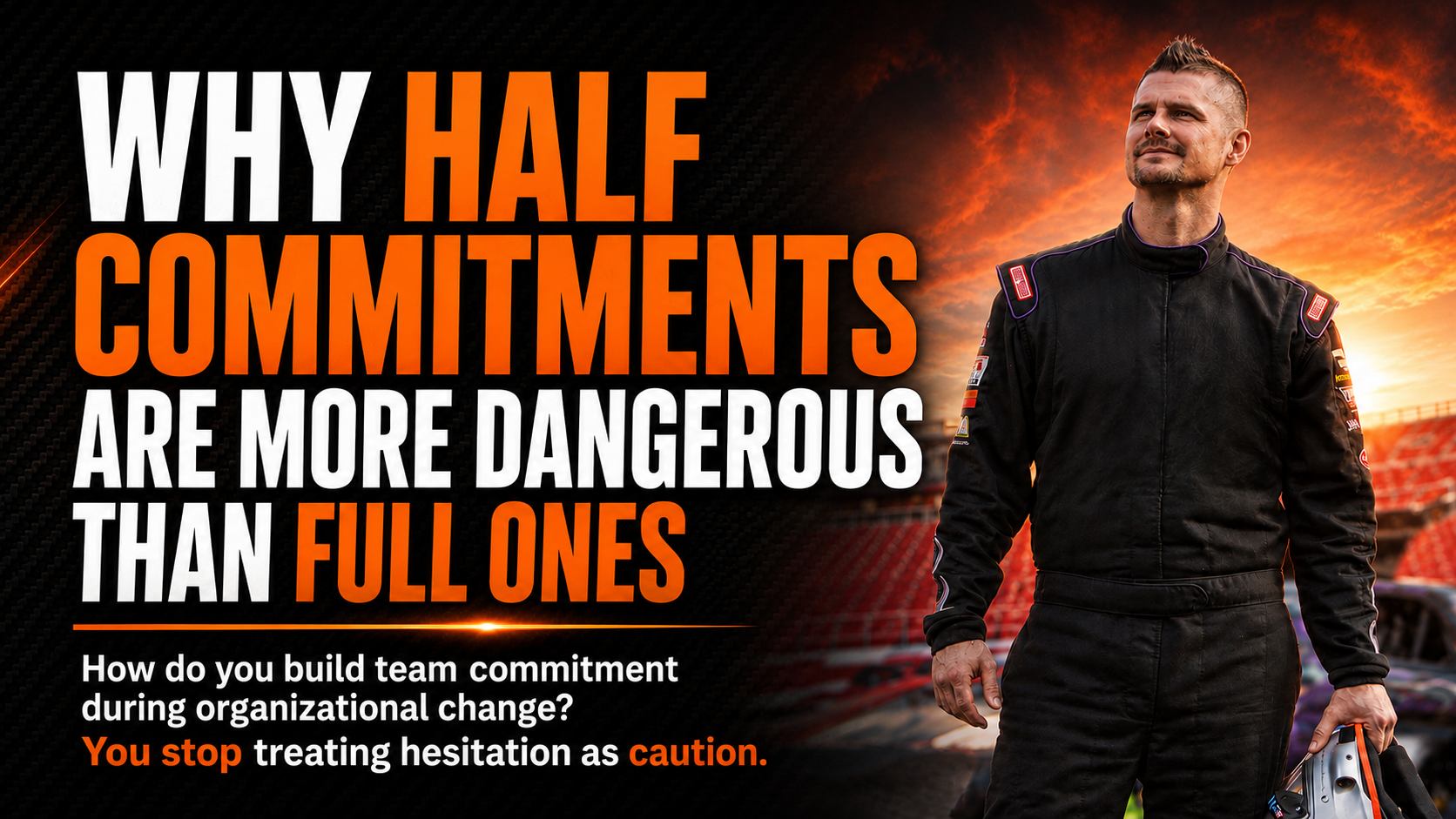
How do you build team commitment during organizational change? You stop treating hesitation as caution. A team member driving a change initiative with one foot on the gas and one foot on the brake is not being careful, they are being dangerous, and the half commitment usually costs more than the risk they were trying to avoid. I learned that in a monster truck, in front of 40,000 people, the first time I ever attempted a backflip.
I am Bryce Kenny, a Guinness World Record holding Monster Jam driver and leadership keynote speaker, and I build the Engagement gear of my G.E.A.R. Framework on a moment I would rather forget. The G.E.A.R. Framework has four gears, Growth, Engagement, Acceleration, and Risk, and the Engagement gear is the one leaders misread most often. They think it is about motivation. It is not. It is about commitment, and specifically about what happens to a team when that commitment is only halfway there.
Here is the story, the corporate pattern it exposed, and the hidden cost that surprised even me.
The backflip that became a back flop
Early in my monster truck career I was handed the Great Clips Mohawk Warrior, with Great Clips coming on as a brand new sponsor. My very first event with them was in Minneapolis at the Vikings stadium, about 40,000 people in the seats. Great Clips had 300 people from their corporate office in the building, and the president of the company was there to watch.
Monster Jam told me they wanted me to do a backflip. I had never done one. Their advice was simple: go find another driver and ask how. So I went to a driver named Scott, a guy I had never once seen crash on a backflip attempt. He told me exactly what to do. Turn and face the obstacle, pick a spot the size of a quarter, and focus on it all the way in. The moment the front tires touch, give it 100 percent throttle so the truck bounces off the box. As soon as dirt comes back into your field of view, let off, hit the brakes, and hope you land it.
Monster Jam went straight to the Great Clips president and announced the good news: Bryce is going to do his first ever backflip, tonight, right here in front of you. Then they sent me out.
I did everything Scott told me, to a tee. Steadied the truck, focused on my spot, hit the throttle when I hit the box. And the truck just flopped onto its roof. It never rotated, never really left the ground. I crashed. I joke now that it was not a backflip, it was a back flop. The Great Clips president leaned over to our Monster Jam contact and said, well, you could tell it was his first one. Brand new sponsor, brand new truck, and it already felt like a terrible start to the relationship.
Watch the full story below:
What I did not know is what cost me the moment
I could not figure out why I never bounced into the air, so I went back and watched all the video.
Here is what happened. As I approached the obstacle, I brought my left foot up near the brake pedal to steady myself. Then I never dropped it back down. I was not prepared for how abrasive and abrupt the hit against that metal container would be. When the truck slammed into the box, the impact threw my left foot forward just enough to tap the brake, and that tap killed all of my momentum. That is why I flopped instead of flipped.
What I did not know cost me the moment. And that is exactly true in corporate America: what we do not know usually costs us the most. My foot near the brake was a safety instinct. It was also the single thing that turned a backflip into a wreck.
What a half-committed team actually looks like
Once I saw it on the truck, I started seeing it everywhere in business. So many teams approach their work with one foot on the gas and one foot on the brake. The brake pedal is their plan B, their safety net, their quiet question: if this does not work out, if the team does not perform, if the organization does not grow, what is my backup?
Half commitment is not an attitude you have to guess at. It is behavior you can watch. In a half-committed team you see it in the meeting room:
No one really speaks up, and when they do it is halfhearted.
People throw out ideas but pull back the second someone might say "great, you go run with that."
Nobody wants to grab the initiative and say "yes, I will lead that," because they are afraid of being corrected or being wrong.
There is a visible delay in confidence, in body language and in who is willing to own a role.
This is why half commitment is more dangerous than low morale. Low morale is loud and obvious, so you address it. Half commitment looks like participation. The person is present, agreeable, technically on board, and quietly keeping a foot near the brake the entire time. Just like the truck, a half commitment can be more dangerous than a full one, because the moment the initiative hits harder than expected, that foot taps the brake and kills the momentum.
The Engagement gear is about confidence, not motivation
Executives sometimes misread the Engagement gear as a motivation problem. It is not. It is a confidence problem.
There are people on every team waiting for permission to win. They are waiting for someone to tap them on the shoulder and say it is your turn to step up. The reason they do not give themselves that permission comes down to two questions, and they need a yes to both:
Do I clearly understand my role on this team?
Do I believe my role directly helps this organization reach the vision leadership has set for the next 6 to 18 months?
You need both sides of that coin. Someone can fully understand their role and still doubt that the company can hit its targets, and that doubt alone is enough to keep a foot on the brake. When both questions are answered yes, confidence grows, resistance falls away, and the person stops asking to be motivated. It was never about motivation. It was about position: positioning someone to draw a line in the sand and say, we are going to win, I know how, and I believe this organization will get there the way leadership says it will.
This is the same principle behind building leadership momentum even when you do not feel ready: confidence comes from motion and clarity, not from waiting to feel ready.
How to get skeptical senior leaders to take this seriously
Senior leaders often want to manage change incrementally, one careful step at a time, one foot always near the brake. The backflip story is how I show them why that instinct backfires.
A monster truck can only complete a backflip through full commitment. A half commitment is not the safe middle option, it is the most dangerous option on the floor, because a partial input at the moment of impact is what throws you onto your roof. The same is true of a change initiative. The safety net a team reaches for is often the exact thing that guarantees the crash they were bracing for. Once a room of leaders sees that the "cautious" approach is the risky one, the Engagement gear stops sounding like a soft people-topic and starts sounding like a performance decision.
The hidden cost of half commitment
Everyone expects the obvious cost of half commitment: the change does not fully get adopted. That is real, but it is not the one that surprises leaders.
The hidden cost is turnover. Think it through. If a person does not believe in their role with clarity, and does not believe their role has real impact on where the organization is going, they start looking elsewhere. They go looking for a plan B and a safety net, because they do not believe the 6 to 18 month goal is actually achievable. So they rest a foot near the brake, the team attempts its backflip, and when the execution wobbles they pull the ripcord. You do not just lose the initiative. You lose the person. That is the cost that shows up months later, long after the meeting where the half commitment first went unnoticed.
Frequently Asked Questions
What does a half-committed team look like in the workplace?
A half-committed team participates without owning anything. In meetings people stay quiet or speak in halfhearted terms, offer ideas but retreat the moment they might have to lead them, and avoid grabbing initiative for fear of being wrong. It looks like agreement, which is what makes it harder to spot than open resistance.
Why are half commitments more dangerous than full commitments?
Because a partial input at the wrong moment causes the crash. In a monster truck, a foot resting near the brake taps it on impact and kills the momentum needed to complete the backflip, turning it into a wreck. On a team, the safety net of a plan B is what stalls a change initiative right when it needs full commitment to clear the obstacle.
Is the Engagement gear about motivation?
No. The Engagement gear is about confidence, not motivation. People commit fully when they clearly understand their role and believe that role directly helps the organization hit its 6 to 18 month goals. Once both are true, the resistance disappears without any motivational push.
What is the hidden cost of a half-committed team?
Turnover. When people do not believe their role matters to where the organization is going, they quietly look for a backup plan and eventually leave. The obvious cost is a change initiative that never fully lands, but the cost most leaders miss is losing the people themselves.
Conclusion
A half commitment is not the cautious choice, it is the dangerous one, because the safety net you reach for is usually what causes the crash. That is the heart of the Engagement gear in the G.E.A.R. Framework: commitment is a confidence decision, and turnover is what it quietly costs when leaders get it wrong. Full commitment, it turns out, is less risky than everything we were taught to believe.
Bring the Engagement Gear to Your Next Conference
Bryce Kenny delivers the G.E.A.R. Framework as a keynote to franchise conventions, corporate conferences, and association events. If your team is stalling on a change initiative with one foot on the brake, this keynote gives them the confidence to fully commit and the clarity to know their role matters.