
Adapting to AI at Work: What My Daughter Taught Me
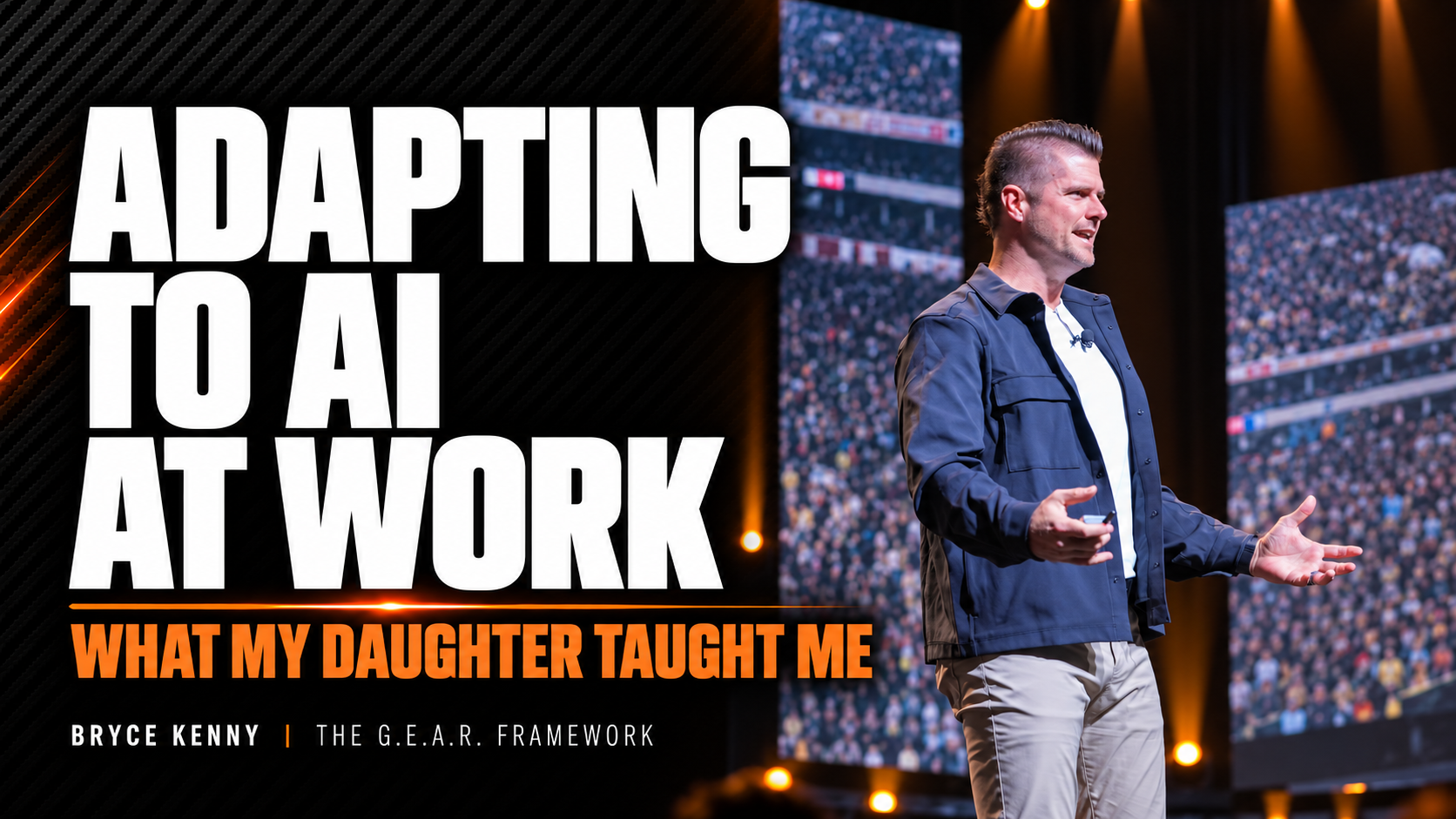
Adapting to AI at work has less to do with mastering the tools than with staying willing to learn. The tools will keep changing. The people who stay ahead use AI to grow what they are capable of, not just what they can produce, and they are willing to experiment before they have it all figured out.
I didn't learn that in a boardroom. I learned it sitting at home, watching what AI did for my 10-year-old daughter, Eliza.
I'm Bryce Kenny. My name is on a Guinness World Record as the first Monster Jam driver to break 100 mph, and today I work as a leadership keynote speaker with organizations like Deutsche Bank, Chick-fil-A, and KOA. I'm not an AI expert, and I won't pretend to be. I'm a dad who watched a piece of technology change the way his kid saw herself.
Here is that story, what it taught me about the right and wrong ways to use AI, and what I'd tell any leader whose team is anxious about what comes next.
AI and Human Performance: What My Daughter's AI Teacher Showed Me
AI can raise human performance when it helps a person learn the way they actually process information. I saw that firsthand with my daughter.
Two weeks into her fifth-grade year, we got a note from Eliza's principal. She wanted to meet with my wife and me, along with Eliza's three teachers, because they were seeing some deficiencies and wanted to get ahead of them early. Eliza has always been incredibly bright. But the traditional way information was being taught to her wasn't always the way she processed it best.
The teachers were kind, and so were their recommendations, including cutting down the number of questions on her tests. I thanked them for calling the meeting. Then I told them I didn't want to lower the bar for her. I wanted to find another way to adapt to what she needed.
So I went home with a plan. Every time her folder of schoolwork came home, I would upload every file and every answer to AI, week after week, so it could start noticing patterns even her teachers might miss.
Then I built her a virtual teacher. We called her Ms. VI, for "virtual AI." Yes, it's a little redundant, but Eliza thought it was clever too.
For 10 to 15 minutes a day, Ms. VI would take what Eliza was learning and explain it differently. It might slow down or ask her different questions, and it kept adjusting until the dots connected for her.
I'll be honest: at first I had the same resistance I hear from people about AI today. Is this cheating? Is she actually learning? Are we becoming too dependent on a tool?
Then I watched her confidence change. Eight weeks later (not a year, eight weeks), Eliza had gone from the Ds and Fs she started the year with to finishing the quarter with all As and Bs.
The grades were great, but that's not the part that got me. It was the way she started looking at me, like she was asking, "Dad, I'm actually good at school, aren't I?" And I'd tell her, "Yeah, baby, you're good at school."
Here is the takeaway: AI did not make Eliza smarter. It made learning simpler. Used correctly, it helped her discover a capability that was already there.
That's when I started thinking bigger. If this can change the way a kid sees herself as a learner, what could it do for an employee, a leader, or an entire organization that's willing to learn differently?
Growth Mindset in the Age of AI: Racing Fuel or 87 Pump Gas?
A growth mindset in the age of AI means using the tool to increase your capability, not to replace your thinking. That idea comes straight from the G.E.A.R. Framework, my four-gear model for peak performance: Growth, Engagement, Acceleration, and Risk. Growth is the first gear, and it rests on one principle: what you put in the tank determines what you get out.
My Monster Jam truck makes 1,500 horsepower. You can't pull it up to a gas station, fill it with 87 pump gas, and expect it to perform the way it was built to. It runs on a very specific racing alcohol fuel.
AI might be the most powerful fuel pump we've ever had access to. But you still have to decide what you're putting in the tank.
For a high performer, AI should increase your ability to learn, to think, to experiment, and to do something you couldn't do before. If I use AI to:
challenge an idea,
teach me something faster,
expose a blind spot in me, or
explore ten approaches I never would have considered,
then I'm growing.
The 87 pump gas version of AI is using it to avoid thinking altogether. If I ask it to do all of my thinking, accept its first answer, and paste something I don't fully understand, I'm slowly outsourcing my own capability.
Is AI the New Comfort Zone?
I think AI can become the newest comfort zone for all of us. It's incredibly easy to feel productive, because the output looks impressive. So I keep coming back to one question:
Is this tool increasing what I'm capable of, or is it just increasing what I'm capable of producing?
Those are not always the same thing. The people who learn to use AI to increase their own capability are the ones who will have an incredible advantage as we move forward.
AI Anxiety at Work Is a Growth Test
AI anxiety at work usually comes down to uncertainty, and the answer to uncertainty is learning, not prediction. Here is what I'm hearing inside organizations right now:
People want to know what AI is going to do to their jobs.
Owners are wondering which tools they should adopt.
Leaders are worried their competitors are figuring it out faster than they are.
Employees are wondering whether getting more efficient with AI will eventually make them less necessary.
I understand that anxiety. When I told Eliza's story on stage for KOA, the room had heard a presentation on AI that same morning. I asked how many of them, if they were honest, were thinking AI was probably for someone else on their team. That's a normal reaction, and it's exactly the comfort zone that keeps people stuck.
My reframe is simple: AI disruption is first and foremost a growth test, and adapting to AI at work starts with learning, not with picking the perfect tool. In the G.E.A.R. Framework, the question for the Growth gear is, what do we need to learn? That's exactly where I'd start.
Leading Through Technological Change: Start With One Thing to Learn
Leading through technological change doesn't require predicting the future. It requires getting your people learning now, which is what adapting to AI at work really looks like inside a team. Instead of trying to forecast exactly what AI will look like three years from now, here is what I'd do:
Pick one thing. Identify one thing your role or your organization needs to learn how to do with AI right now.
Give people permission to experiment. Make it safe to try something before anyone knows whether it will work.
Bring back what you learned. Have people share what worked, what didn't, and what they learned.
Involve the people doing the work. Let them help decide where AI can actually make the work better.
That last step matters most. Adoption gets so much easier when people have ownership in building the solution. It's the same reason I tell leaders that ownership outlasts incentives.
We're all going to get some of this wrong, because the tools are changing too quickly for anyone to have a perfect playbook. But the organizations that stay ahead will be the ones willing to keep learning while everyone else waits for certainty.
Staying Relevant in the Age of AI: What Doesn't Change
Staying relevant in the age of AI depends on something no tool replaces: your willingness to learn. Twenty years from now, the tools will be completely different. The people who stay willing to learn will be the ones who stay ahead.
Every new technology eventually creates a new comfort zone. You learn the tool, it starts working, you get comfortable with it, and eventually something better comes along. The danger is building your identity around being good at a particular tool instead of becoming really good at learning.
I say it from the stage: the number one thing I've noticed about the people who make it is that they simply spend more time outside their comfort zones than other people. AI doesn't change that. It raises the stakes on it.
That's why I'm experimenting with AI constantly right now. I'm using it in my business, testing where it can save me time or money, and letting it challenge my ideas. I'm trying things before I completely understand where they'll go. Some experiments are great and some are terrible, but I'm building the muscle of learning how to learn, and that's the part I want to keep.
Frequently Asked Questions
How do you stay relevant in the age of AI?
Get really good at learning, not just at a particular tool. The tools will keep changing, so building your identity around one of them is risky. Experiment regularly, keep what works, and use AI to stretch your thinking rather than replace it.
Is AI making people better or worse at their jobs?
It depends on how they use it. Used to challenge ideas, learn faster, expose blind spots, and explore new approaches, AI makes people more capable. Used to skip the thinking, accept the first answer, and paste work they don't understand, it slowly outsources their capability, even when the output looks impressive.
What skills won't AI replace?
The willingness to learn and to get uncomfortable. The people who make it tend to spend more time outside their comfort zones than everyone else, and that stays true no matter which tools come next. Curiosity and the ability to learn how to learn are the advantages that last.
Finding Your Next Gear When the Tools Keep Changing
Adapting to AI at work isn't about keeping up with every new tool. It's about making sure the tool grows you, the way Ms. VI grew Eliza's belief in what she could do. That's what finding your next gear looks like right now, and it's why Growth comes first in everything I teach.
Twenty years from now, I have no idea what AI is going to look like. But I do know this: comfort will still be expensive, and curiosity will still be an advantage.
Bring the AI Growth Conversation to Your Next Conference
Bryce Kenny shares Eliza's story as part of his G.E.A.R. keynote for franchise conventions, corporate conferences, and association events. If your people are anxious about AI, or using it to produce more without growing more, this keynote gives them a practical way to treat AI as a growth test: permission to experiment, and a shared language for telling racing fuel from 87 pump gas.
Check availability for Bryce Kenny as your keynote speaker →